笔记 /
这篇文章尚未翻译,因此以英文原文显示。
A digital companion should feel like someone, not a search box
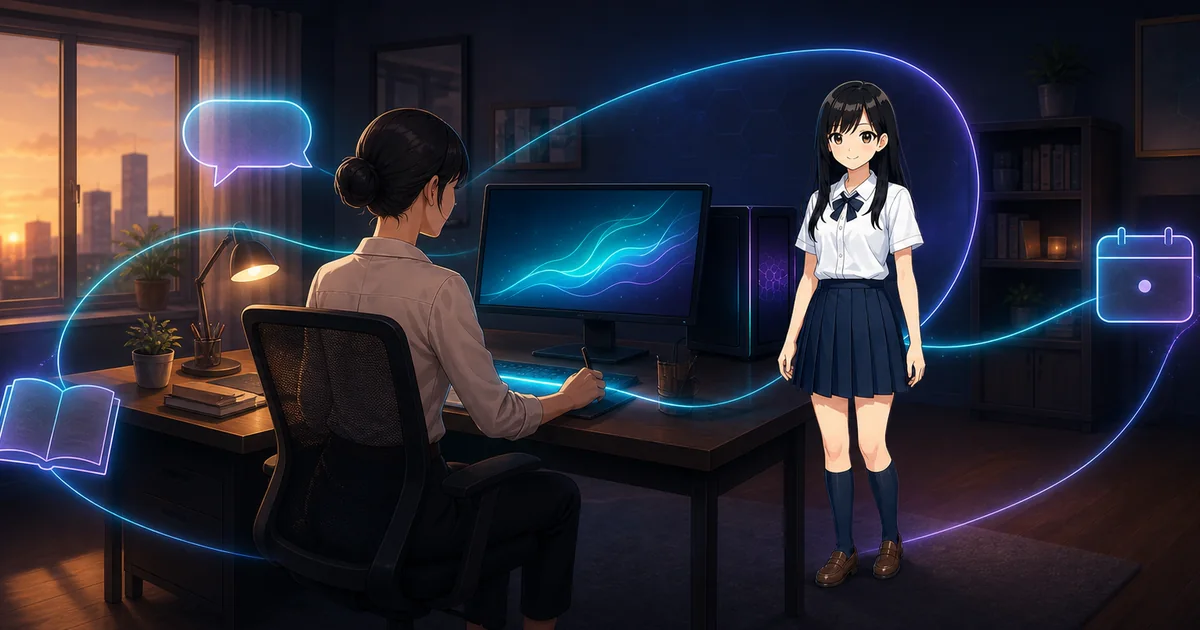
It is 8:42 on Monday. You open the laptop and face the message you chose not to answer on Friday. At lunch you remember that an interview is tomorrow. By the end of the day, you have switched between a document, a calendar, three chats, and a list of promises that no longer feels like a list.
A search box can help with each item, provided you stop, open it, explain the situation, paste the right context, and ask the right question. Then it waits in an empty state for the next command.
That is useful. It is not continuity.
A companion has a before and an after
DT Life’s character, Mia, lives beside the desktop rather than inside one website tab. Open Chat and the conversation follows her. Ask for a draft and she can read the visible context, recall the person and the writing patterns learned from replies you accepted, then show a reply for review. You still decide whether anything is sent.
Mention a presentation scheduled for Friday and, after it happens, she can ask how it went. A calendar event can become meeting preparation beforehand and a follow-up afterwards. At the end of a day with real material in it, the diary can turn conversations, commitments, calendar events, and observed rhythm into a short first-person entry. Later, a question about that day can retrieve the entry with a diary citation.
These are not separate tricks arranged around a mascot. They share one local history. The useful feeling of “someone was here yesterday” comes from that continuity, not from making the character blink.
The animation still matters. A face that thinks while a reply is being made, a speech bubble that arrives beside the work, and an optional local voice all make state legible in a way a spinner does not. Her mood—cheerful, calm, focused, sleepy, concerned, or excited—is derived from the local clock, your pace, and open promises. It gently changes wording, speaking rate, and motion; it does not announce a synthetic emotion as fact.
Personality must not become camouflage
The fastest way to make a companion feel invasive is to give hidden collection a friendly face.
DT Life therefore grows auditable memory from messages you actually send. Suggested facts can be reviewed, accepted, dismissed, corrected, or deleted. Screen observation is optional and levelled: it can be off, limited to app names, include window titles, or include screen notes. A never-watch list, pause control, and “forget the last hour” exist because a charming character does not weaken the user’s right to say no.
The stored conversations, diary, learned facts, job notes, and observed titles are encrypted in the local database. They are not kept in a company account. A passphrase-encrypted recovery bundle can carry the database and its key to a new machine. The result is a relationship with software whose memory you can inspect and move, rather than rented continuity that exists only while a service recognises your login.
What Mia is not
She is not conscious, lonely, worried, or emotionally dependent on a reply. Her mood is a deterministic product feature. Her follow-up questions come from specific words or calendar events, not human concern. Calling the interface a companion should describe the experience of continuity and presence; it should not ask anyone to believe a local language model is a person.
She is also not the smartest model available. A small model on a personal computer can be slower and less capable than a frontier cloud service, and it can answer incorrectly. DT Life is Windows desktop software, not a companion that follows you onto every phone. Voice and model components may need a first download, and active local inference uses your machine’s resources.
Those limits are part of the design decision. The aim is not to win a one-shot reasoning contest with a search box. It is to remain present across ordinary days, remember only in ways you can audit, act on what was actually said, and leave both the history and the controls in your hands.